Signs Your Trucking Company Has SaaS Sprawl (And What It's Actually Costing You)
Sprawl in most industries is a vague, hard-to-trace inefficiency. In trucking it's almost always one of two specific overlaps, and the cost is traceable to a line item, not a guess.
Unchecked sprawl costs trucking companies $3,624-4,024/mo — consolidation gets that back to $2,574-3,134/mo
For a 20-person trucking company running one extra load board or ELD platform beyond what it needs.
In trucking specifically, sprawl has an unusually clean signature. It's rarely a mystery subscription nobody remembers signing up for — it's running two load boards or two ELD systems at once, because a driver hire, a fleet acquisition, or a 'we'll cancel the old one later' never got followed through. That pattern is rarer in most industries; in trucking it's the single most common form of sprawl we see, and unlike a lot of software waste, its cost is exactly traceable to a line item, not a vague inefficiency.
Two load boards or two ELD platforms doing the same job is the most common — and most expensive — sprawl pattern in this industry.
Signs your fleet's software stack has sprawl
- Are dispatchers actively posting the same loads on both DAT and Truckstop, or is one of them just a leftover habit from a driver hire?
- Are trucks running both Samsara and Motive hardware because a fleet acquisition never got consolidated onto one ELD platform?
- Is factoring through RTS Financial (or another factor) still running even though the business now has stable shipper contracts and cash reserves?
- Does your bookkeeper manually re-key load revenue from the TMS into QuickBooks instead of it flowing through automatically?
- Could anyone in the office state the combined monthly software bill within 20%, right now, without opening the bank statement?
The exact cost of the two most common overlaps

A structured audit of billing statements — not a gut-check — is what actually surfaces these overlaps.
What duplicate tooling actually costs
| Overlap | Extra monthly cost | Pillar |
|---|---|---|
| Running DAT and Truckstop.com simultaneously | $140-150 | Sales & Marketing |
| Running Samsara and Motive simultaneously | $750-900 | Core Operations |
| Factoring kept active after cash flow stabilized | $400 | Finance |
| Legacy ELD hardware contract kept 'as backup' | Illustrative — check your device contract term | Core Operations |
How the two overlaps stack the bill
The riskiest sprawl signal isn't the priciest one — it's a legacy ELD hardware contract kept 'as a backup' after migrating to Samsara or Motive. Unlike a load board subscription, hardware contracts often run multi-year terms, so 'we'll cancel it later' can mean another year or two of double-paying, not a quick fix next month.
A 30-day sprawl audit for a trucking company
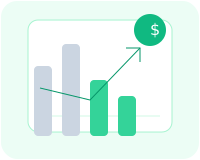
Consolidation savings show up fast once the redundant load board or ELD contract is actually closed out.
A 30-day sprawl audit for a trucking company
- Week 1: Pull every load-board, ELD, and factoring charge off the last three months of bank and card statements — not what dispatch remembers.
- Week 1: Flag anything billing twice for the same job — both load boards, both ELD platforms, a legacy device contract.
- Week 2: Check your actual factoring utilization — if you're only advancing against a small share of invoices, you may be paying $400/mo for a safety net you no longer need.
- Week 2: Confirm the hardware contract term you're actually locked into before assuming you can cancel next month.
- Week 3: Cancel or fully migrate off the redundant load board or ELD platform, with a firm cutover date.
- Week 4: Re-run the total and confirm it lands near $2,574-3,134/mo for a fleet your size.
Consolidation here almost never means cutting a federally mandated tool — it means finishing a migration you already started, and revisiting a factoring line once the cash-flow problem it solved is gone.
Run the free audit with your real fleet size and current spend to see exactly where your stack stands.